


There are some women whose presence tells a story before they even speak. Women who have not only built something lasting, but have also done so in the face of criticism, cultural expectation, invisibility, and a world that did not always know what to do with their confidence. Women who have carved out space not by asking for permission, but by standing firmly in who they are.
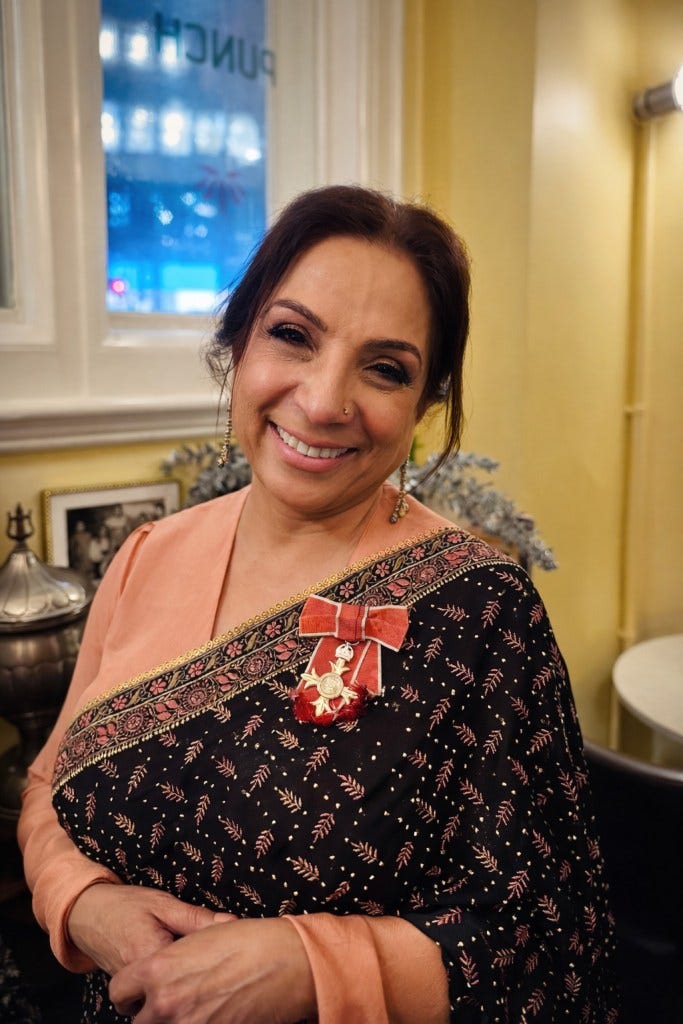
That is exactly what came to mind as I sat with the story of Mani Kohli MBE. A pioneer in British South Asian fashion, Mani has spent decades shaping how South Asian women see themselves and how they allow themselves to be seen. Through Khubsoorat, she helped bring elegance, tailoring, visibility, and cultural pride to women who had too often been taught to shrink, cover, or blend in. But what struck me most in this conversation was not only her creative legacy. It was the force of the woman behind it.
Because beneath the glamour, craftsmanship, and decades of entrepreneurship is a story of grit, self-belief, survival, reinvention, and a woman who kept going even when life demanded more of her than most people ever saw. We talk about confidence, adversity, divorce, self-worth, menopause, leadership, legacy, and what it means to keep becoming, especially in midlife, when the body changes, the energy shifts, and life asks you to meet yourself in a new way.
This is a conversation about visibility, yes. But also about endurance. About identity. About style as self-expression. About building a life on your own terms, even when it comes at a cost. And perhaps most of all, it is a reminder that midlife is not the end of a woman’s relevance. In many ways, it is the chapter where everything she has lived begins to make its deepest sense.
When you look back over your journey, what do you think midlife has asked of you that your younger self couldn’t yet understand?
The first thing that came to my mind was my inability to handle my mood swings and irritability. As I had no guidance, I found myself facing the highs and lows of my daily life, as normal, yet by the time I was ready to hit the bed, I was exhausted, physically and mentally, blaming my stressful life of choice.
Your work has helped shape the visibility of South Asian fashion in Britain. What did you have to believe about yourself to keep going when the wider culture wasn’t ready?
I did find it quite shocking to meet women in the late 1970s and early 1980s when I arrived in Britain in 1977, who camouflaged behind layers of oversized fabrics, cardigans and coats. Loose-fitting, self-tailored clothes, more to cover than enhance.
At the few outings that I attended, I designed and tailored my own Indian suits, which showed more of my shape and my confidence to be seen in them. Even my saree blouses were stitched to enhance my body shape, and saree draped to show off my curves.
I saw the gap and introduced the well-tailored suits to enhance and be seen to fit in the environment. I did not turn to predictable Indian fuchsia, turquoise, and reds, but subtle shades of browns, nudes, blues and greys, that seemed to set the trend and tone, yet culturally uphold the roots. It was so satisfying to see more women wear my creations on the streets and feel right in them. It purely stemmed from confidence and self-belief to be visible when racism was intense.
You’ve built a legacy over decades. What keeps you creatively alive now, and how has your relationship with ambition changed in midlife?
Legacy exists because I believed in my fashion sense and the confidence to uphold it. Today, the mainstream has turned to Asia for inspiration, where we feel comfortable addressing our attire with modernity and are proud of the craftsmanship that exists in parallel to digital essence. I have been addressing
it for 4 decades now with ease. When I started my investment in fashion, it was a challenge to create a source of income. Over time, the ambition and desire to be visible overtook the entrepreneurship to scale the supply, to meet the demand, and its purpose as the glamour and glitz it provided for the discerning women, who were beginning to find themselves and their identity.
Midlife can bring a new relationship with the body, confidence, and “being seen.” In fashion, that can feel loaded. What do you want women in midlife to know about style as self-expression, not performance?
It is very important to be comfortable in your skin before you are seen. The onset of midlife comes with lowered confidence, as youth is not in the forefront to battle. Wear what suits your frame, not what fashion dictates. Impressions count, without staging them.
Dressing in comfort and adding style to it is an art. Regular indulgence in try-ons at stores, new make-up and accessories to enhance, can clear your expression. I find there is so much help around now to decide on your esteemed look, which was one big hindrance in my crisis time, as compliments were hard to get and self-expression itself a huge challenge!!! Knowing oneself and enhancing one’s personality is the key to identity and creating presence.
You’ve spoken about resilience and adversity shaping your path. What did rebuilding your life teach you about self-worth and standards, especially as a South Asian woman?
At the time I started my adventure with my business and building a home for my kids, there were enough people around to put me down for my individualist approach. I could not be “modern” in my dress sense or my expression, as women of that era did not do it, especially with the “stigma” of being a “divorcee”. Outspoken was the intense criticism I had to face, as I was practical and clear with my statements.
Most saw me as a rebel, as I would go against the norms laid out culturally to follow. I had to turn a blind eye and pretend to be deaf, as I could not understand how I was meant to build my own income and fend for my children, if I could not stand upright and fight for my space and voice! Steering clear of criticism was the only format I adopted to be visible and establish my vision of self-reliance. The South Asians felt I was aggressive and non Asians couldn’t fathom my spirit as normal, because of my colour.
So many women are the backbone of everyone else’s life. What are the boundaries or non-negotiables you’ve had to put in place to protect your energy as you’ve grown older?
I was barely 20 when I had to put my foot down to assert my authority to be an independent woman, who wanted to earn for myself and set standards for my own life, that too in a foreign land. A few cries from my siblings and colleagues at the time!! Besides, I was a graduate from convents in India, so language and understanding certainly were non-negotiable. I could not, and would not, put up with the atrocities from my ex/late husband, whose mental and physical abuse was overridden or challenged at every stage, single-handedly by me. I was a warrior who had set a path and decided to fight and surmount every possible obstruction that stood in my way as an individual, as a provider for my family and as a visionary for my fashion label. I guess the energy was derived from my genes!!
Khubsoorat has always held this blend of heritage and modernity. How do you personally navigate that same tension: tradition, duty, family expectations… and choosing yourself?
It is indeed very heartening to learn how the “Khubsoorat” label is perceived. It was my stance and vision when I chose fashion as a language to express myself and my vision. I never started this investment as self-centred. I was always representing my upbringing and roots. So, I never set out to correct either tradition, duty or expectations. If at all…The expectations and goals were set for me to meet by enhancing and balancing my heritage. I did burn the candle at both ends for it. Even in the present day, I have had to evolve my thought process to meet the expectations of the new consumer, without compromising on my identity. I do have to satisfy my inner creatives before displaying for the people to appraise.
What has menopause or the midlife transition (in any form) taught you about leadership: how you lead, how you hire, how you mentor, how you say no?
This has been one mighty ask from myself!!!! I was 42, at the peak of my fashion business, when I had a full hysterectomy and my ovaries removed. I was neither mentally nor physically prepared for the ongoing journey. Nobody even paid heed to it, let alone understood the sufferings of the bearer. So sympathy is never sought or given.
I met the staff as a listener when I wanted to tear my hair out. Assuring that one can overcome highs and lows was the worst when I used to wake up in sweat in minus temperatures and a mind on overdrive, to advise the next generation on bettering their lives. I never learnt to say NO… it would mean not giving myself or the person who stood in front of me, a chance to fall and learn. Experience is the biggest teacher of all journeys… the rest comes as sermons!!!
You’ve supported artisans and heritage crafts. What does legacy mean to you now: what you leave behind, what you pass on, and what you want to protect?
Having experienced the build on my own risk, I can certainly affirm that legacy is not a terminology that one can phrase as inheritance; it is a process that needs to be enriched by the framework, by the builders, be it artisans or crafts. It has to be preserved by a caring generation as a precious learning.
If you could speak to the woman at 40+ who feels invisible, exhausted, or like her best years are behind her, what would you say to her plainly and directly?
DON’T be harsh on yourself. Lower your own expectations. Learn to accept and not fight, as circumstances all fall into place. And when you are near a ripe age, you will only look back and laugh at yourself, as you alone know the path you walked on, and what it took to get you this far!!!
What stayed with me most after reading Mani’s answers was the strength of a woman who refused to disappear. Not when culture tried to contain her, not when criticism tried to quieten her, not when midlife and menopause arrived without guidance, tenderness, or understanding, and not when life demanded she keep building, leading, mothering, surviving, and showing up through it all.
There is something deeply moving about a woman who has lived enough to speak without pretence. Mani does not offer polished inspiration. She offers something far more valuable: lived truth, the kind that comes from having walked through fire and still choosing to create beauty, the kind that knows legacy is not a title you inherit, but something you build, protect, and pass on through courage, vision, and consistency.
What I also love is how clearly she reminds us that being seen is not vanity. It is self-possession. It is identity. It is a woman deciding that she will no longer apologise for her presence, her style, her voice, or her standards.
For so many women in midlife, especially South Asian women, there can be a quiet temptation to believe that the best years are behind them. That confidence belongs to youth. That visibility belongs to someone else. That desire, ambition, beauty, and reinvention have an expiry date. Mani’s life says otherwise.
She reminds us that midlife is not a fading. It is a reckoning. A refinement. A season where you begin to understand what it really took to become yourself.
And maybe that is the deeper invitation here: to stop being so hard on ourselves, to honour the road we have walked, to dress for the woman we are now, to protect what matters, to trust what we know. And to remember that the life we have built, and are still building, carries its own kind of beauty, because there is nothing invisible about a woman who knows who she is.