


For some women, reinvention begins with a grand plan. For others, it begins with a quiet realisation: I have spent so much of my life being everything to everyone else that I haven’t stopped to ask who I am becoming.
For Punam Saxena, that question arrived after decades of putting family, education and responsibility first. A daughter. A wife. A mother of four. An educator who spent more than 35 years advocating for children with special needs and the families supporting them. And, somewhere along the way, a woman who had learned how to navigate two cultures while often feeling as though she belonged completely to neither.
Punam describes herself as a true ABCD, an American-born child of Indian parents who grew up in a community where there were few people who looked like her, shared her experiences, or understood the strange space between Indian and American identity. As a child, that hybridity could feel like inadequacy. Today, she sees it very differently. It is her superpower.
Now, approaching 60, Punam is building an entirely new chapter. She completed her doctorate in her mid-50s, pivoted her career, and is using everything she learned through education, advocacy, and her own lived experience to support South Asian American girls and women in finding their voice, confidence, and place in the world.
Her story is a powerful reminder that reinvention doesn’t have an expiry date.
In this conversation, we talk about growing up as the only other, the complicated beauty of living between cultures, and the decades it can take to develop the confidence to stop seeing our differences as deficiencies.
We talk about log kya kahenge, the invisible expectations that can keep women living inside boundaries they didn’t consciously choose, and what happens when the answer finally becomes khene do.
We talk about pursuing a doctorate at 54, becoming the person she once needed, navigating the sandwich generation, and why Punam believes the window of possibility remains open for as long as we are willing to prop it back up.
Because perhaps the most radical act of reinvention isn’t becoming someone new.
Perhaps it’s finally giving ourselves permission to become who we were always capable of being.
Let’s talk to Punam.
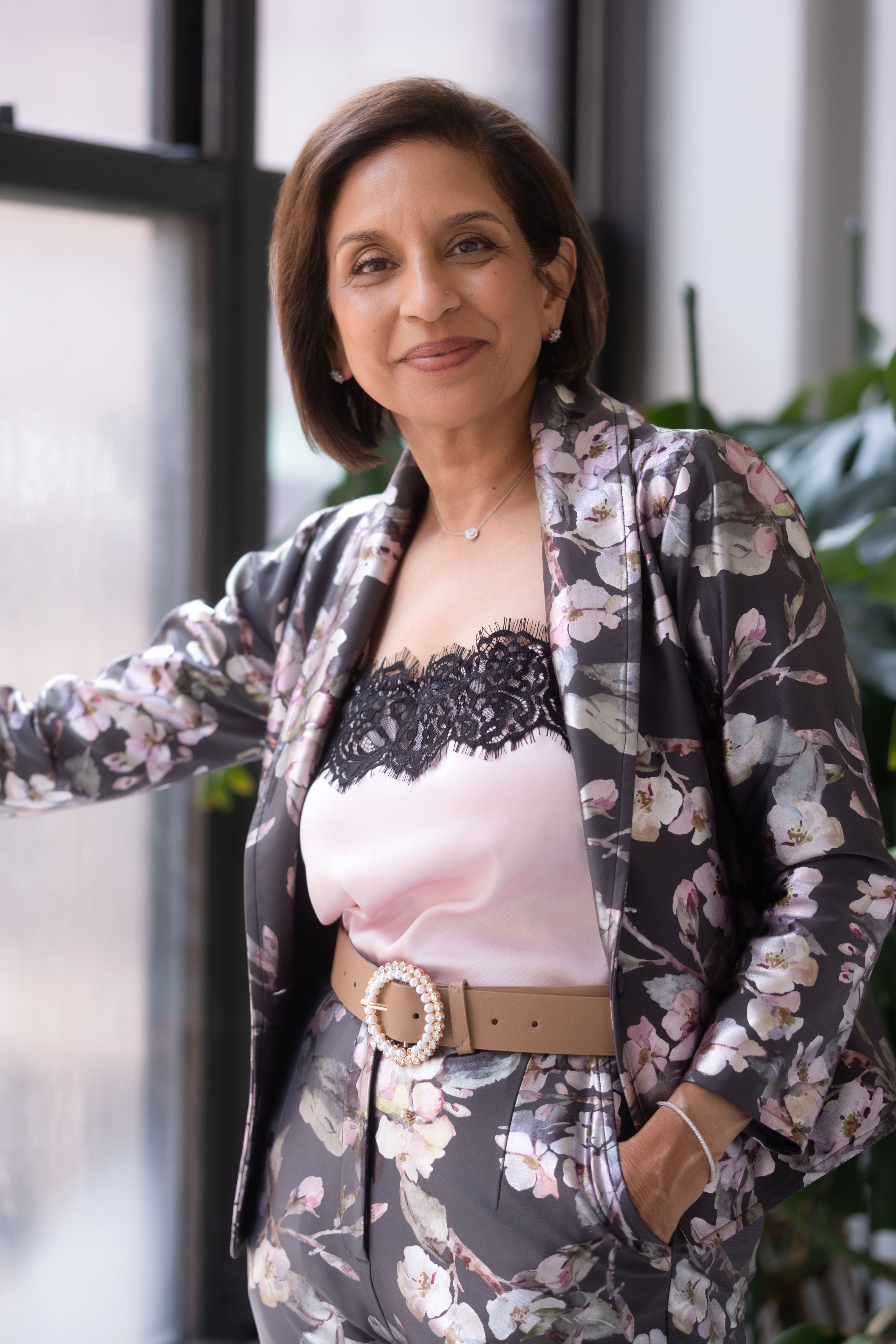
You’ve described yourself as a “true ABCD”, never feeling fully Indian or fully American. Can you take us back to what that felt like as a child, and how long it took you to realise that in-between space wasn’t a deficiency, but an identity in its own right?
During the 1960s and ‘70s, America was witnessing an ethnic transformation: desegregation of Blacks and Whites was occurring, along with opening the borders to Asian countries to enhance America’s innovation and technology sector. With little global knowledge and believing that South Indians were equivalent to Native Americans, our family was thrust into a community with little understanding outside of an ethnically binary society.
We realised early, though, that our family would need to educate our community regarding our culture, heritage, and traditions. We would also need to assimilate so that we felt somewhat integrated.
My childhood was lonely in the sense that there were no second-generation Indians in our community. I did not have a peer or a mentor. I was navigating a space that no one I knew had traveled. My Hindi is fluent enough to convey my thoughts, but the tenses are not always correct, and my English is proficient, but I find myself code-switching at times, making it difficult to find the right words, even though I was born in America.
I was creating an identity, a hybrid identity, that merged my Indian values with an individualistic society. One could genuinely say that I was an ABCD.
As I look back, I am certain that my hybrid identity never wavered. My beliefs have always been strongly rooted in both cultures. However, my peer group made me feel inadequate in my duality, making comments about the disparity of my beliefs, how I dressed, and my unusual accent. However, within the last two decades, I have been able to succinctly discuss the merits, the strengths, and the privilege of that hybridity.
The journey to find my inner confidence took time, almost 30 years. Maybe because I was the “only.” Maybe because of my personality. Now, I see my hybrid identity as a powerful tool to be a voice for others struggling with the same challenges. My unique identity is my superpower.
You spent 35+ years in education, much of it supporting students with special needs. What did that work teach you about advocacy, and how directly do you see that shaping the advocate you’ve become for South Asian American women today?
I became a teacher for students with special needs directly upon graduation from the university. I was idealistic and naive, believing that I could significantly change the trajectory of these students’ lives. Each day, my goal was to ensure their lives were easier to navigate, build an inclusive environment in a world that judged them, and help them find happiness and confidence in their capabilities.
That idealism soon faded; my focus became creating a supportive environment, family members included, that could nurture them throughout their lives. I found that the largest gap in support came from parents; not because of a lack of desire, but a lack of knowledge and understanding of how the system works. Once I helped them understand how to support their child, their children grew and flourished because they were receiving the resources they needed.
I left education after 35+ years to bring that same framework to South Asian American women (SAAW). Immigrant and SAAWs often navigate new experiences that require them to balance their cultural upbringing of hierarchy, filial piety, and education in a country that believes in independence, freedom, and owning your own voice. Without support, resources, guidance, and understanding, they are left to navigate this hybridity on their own, which leads to frustration, uncertainty, and feelings of isolation. My work is to lessen that stress and anxiety, foster understanding and confidence, and empower them to make decisions that align with their beliefs and values while gaining skills for success.
Completing a doctoral degree in your mid-50s and then pivoting your entire career is a bold move by any measure. What was the moment, or the accumulation of moments, that told you it was time to stop deferring this new path any longer?
My mother has wanted me to pursue a doctorate for the past 25 years. She saw her timid and academically unfocused girl grow more confident as an adult and develop strong skill sets in advocacy and education. Though she never pressured me, she would periodically remind me of the opportunity. After raising four children who had graduate degrees, I began to allow myself to think about what I, Punam, the person, could do for self-development.
What cemented this pivot were four factors.
First, I owed it to myself. I did not want to be at the end of my life and regret not trying things that interested me. However, the timing had to be right. For years, I had placed others’ needs before mine, ensuring the children had a strong foundation before leaving for university, that my husband had the support he needed to provide for us, and taking care of our parents. Pursuing a doctorate was a personal journey. In fact, several of my cousins were shocked that I pursued a doctorate. “Why would you do something like that at this age? What do you have to prove?” For me, it is not about proving to someone else that I can do it. It is to prove to myself that I am capable.
Second, my mother, of course, but also my father, who worked hard to instill the confidence I needed to succeed. He watched me struggle academically as a child because of a lack of confidence, and the doctorate gave them both a sense of fulfillment as parents.
Third, I wanted my children to see that achievements and goals are not always linear and not related to age. Society often dictates the appropriate time, age, and sequence of our life events. I refute that and say that there is no “appropriate time.” The time is when we feel it is right.
Fourth, my husband and cheerleader. He has patiently encouraged me to pursue every dream, passion, and endeavor that feeds my soul. In pursuing this doctorate and making this “late-career” pivot, he’s given me the strength to break ceilings, however I so choose.
You’ve said your drive to help others may come from the fact that no one was there for your family growing up. How does it feel to become, in many ways, the person you once needed?
I have long wondered what my life would have looked like if I had a peer. Someone to talk to and confide in. Someone who could understand that my parents were strict by American standards but liberal by Indian standards. Someone who knew what it was like to do pujas on the weekends while others had sleepovers. Someone who was the torchbearer for our Indian traditions while my American peers were dating and partying.
I am proud to stand in this space. I am thrilled to give back to a community that deserves to be seen and validated for who they are. And I am extremely humbled that my clients find comfort and confidence knowing that someone has had similar experiences, validating their own journeys.
My work stems from those experiences in hopes that no other South Asian girl or woman feels lonely or isolated. I am deeply committed to being a changemaker and developing the confidence, voice, and leadership skills that we need to stand as individuals.
As a “second gen” woman, what does the phrase “log kya kahenge” (what will people say?) mean in your world, and how has your relationship with it changed as you’ve moved into this new chapter?
If you had asked me this question ten years ago, I would have answered, “It’s important to recognize our place in the world and work within those parameters.” Today, my answer is a firm, “Khene do” (let them say it). This is not out of disrespect or anarchy or women’s rights; however, we now live in a world where our voices, ideas, and skills matter. Indian women are well-rounded, intelligent, and problem solvers. We can manage both cultures with balance without losing our core identities.
We are true trailblazers.
My relationship with this phrase has changed because I refuse to allow someone’s perception or judgment of me to diminish my mission, work, and passion. “Log kya kahenge” is an underhanded way of saying “Stay in your lane. Don’t bring shame to you or our family.”
There is a difference between following the law and fearing being judged for taking an uncharted path. A different path means that we are authentic to ourselves. True support is unconditional and uncaring of what others may think.
We, as SAAWs, are a formidable group, and it is imperative that we place ourselves in spaces where “Khene do” is acceptable.
You now describe your mission as helping South Asian American girls and women feel seen and valued for their strength and their heritage, in a country that doesn’t always appreciate either. What does that recognition actually look like when it finally happens for a woman?
We often feel that our identities are an either/or situation – sometimes Indian, sometimes American. I reject that notion.
Our identity is about us — our identity, one set of values and beliefs. That does not mean we cannot grow and learn, but our core identity is consistent. My clients and I begin with where they are and the goals they have for themselves. Through our sessions, we work together, create a plan, and implement it over a 3–6-month period.
The moment that everything comes together, the client has this “aha” moment of clarity and vision. It’s magical. They finally realise that validation, emotion, and recognition make them invincible. Confidence grows. Voices become stronger. Dreams become bigger. Our success changes how others view us, the tables we are invited to, and the direction our expertise takes us. They are finally able to see their capabilities and the strength of their dual identity, allowing them to pursue their dreams and passions. It is my favourite moment when working with any client.
Many women in our community were raised to believe reinvention is a young woman’s privilege. What would you say to a woman who feels she has “missed her window” to pursue something new?
The short answer is, “No one can close a window if you do not allow it.”
The long(er) answer is, South Asians have this mindset that whenever they reach a certain age, they are now old and must begin acting as such. This was true when our life expectancy was 60 years. With advances in medical research and technology, our life expectancy has increased, but the mindset has not evolved.
If you believe you are old, you are old. And vice versa. I ran my first marathon at 42, began my doctorate at 54, pivoting my career now.
I would encourage women to see their windows as forever open. There is too much life to live, too much wisdom to share, and too much love to spread.
And if the window seems to slide down, prop it up and see what opportunities it brings you.
You’ve spoken about feeling energised as you approach 60, with more projects than hours in the day. What is it about this stage of life specifically that has unlocked that sense of momentum and clarity, rather than slowing you down?
I know I have fewer days ahead of me than behind me to make the impact I believe I’m destined for. This may sound morbid, but it is reality. Time is my enemy. Though it energises me to create a legacy that embraces my experience, coaching others to step into their true dual identity, and leave a mark on the world that has allowed me to live so graciously.
I have finally found clarity in my purpose – to be the person for others that I desperately needed when I was a child. The ability to help others and educate and mentor them gives me immense personal satisfaction and joy. Each day I wake up with new ideas and projects that I would like to incorporate to help others.
This vision and energy tell me that I am exactly where I should be, and I am on a mission to help as many women as possible.
Bridging two cultures often means also bridging two generations within a single family. What have you learned about parenting and being parented that you think other South Asian women in midlife, caught between ageing parents and growing children, would recognise in themselves?
Let’s acknowledge that this stage is hard. We are pulled from all sides, trying to anticipate others’ needs, and be on standby for any eventuality. I find it inspiring at times, exhausting at others, and thankful for the next. Most of the time, though, I see my role as one of honour and privilege. It is my duty to take care of my parents and provide them with the stability and support they gave me as a child. I want to hear all their childhood stories and understand their immigration experience. I want my children to hear and learn from them and recognize the sacrifices their grandparents made.
Most communication in our South Asian families is top-down. Grandparents share with their younger generations, and parents share with their younger generations. Yet, there is often a lack of substantive communication between generations, such as me sharing my emotions with my parents, sharing their thoughts with me, or me sharing with my children. This can be extremely isolating and frustrating, especially as the one sandwiched between the generations. Sometimes, I want my children to know how I feel, the challenges I am facing, and the successes I have had. It is important for them to know so they can support and guide me, as well as give their advice.
What I have learned is that I must keep the lines of communication open through all generations to ensure everyone feels heard and validated in their stages of life. This has been a critical skill I have learned in order to maintain strong, positive relationships with both generations. And help me stay strong through the rough periods.
If you could speak directly to a woman who still feels like the “only other” in her community, still waiting for permission to take up space, what would you want her to know?
Being a woman can be overwhelming.
Being the “only other” woman can be isolating, leaving you wondering about your worth and toying with your confidence.
Here is what I know.
South Asian women are strong. They are hard-working, dedicated, and compassionate. They are creative in building spaces that were not designed with them in mind.
For too long, we have watched opportunities pass, stayed quiet when we had a better solution, and allowed others to make us feel invisible.
So, to the “only other,” your voice is your power. Your passion is your energy. Your dreams are yours to pursue. Your life is yours to live. If someone asks, “Log kya kahenge?” Do not give it a second thought. The answer is, “Khene do.”
How do I know? I have been there. I have lived it. And I have overcome it.
There is a line from Punam’s story that stays with me: No one can close a window if you do not allow it.
How many women have quietly closed their own windows because they were told, directly or indirectly, that their moment had passed?
Too old. Too late. Too much responsibility. What will people say? What will the family think? What is left for you now?
Punam’s life offers a very different answer.
Her first marathon at 42. Her doctorate at 54. Her career pivot in her 50s. Her decision to build a life and body of work around the very women she once wished had been there for her. None of it followed the supposedly appropriate timeline. And that is precisely the point.
There is something especially powerful about her relationship with log kya kahenge. For years, the phrase can function like an invisible fence, reminding women to stay within the boundaries of what is expected, respectable, and familiar. But Punam has reached a place where her answer is simply: khene do. Let them say it.
Not because other people’s opinions don’t matter at all, but because they no longer get to determine the size of her life.
And perhaps that is what midlife can offer us: the wisdom to realise that we don’t need everybody’s approval before we begin.
Punam’s story also reminds us that identity doesn’t have to be either/or. We don’t have to choose between where we came from and who we are becoming. We can carry our heritage, our values, and our histories with us while still creating something entirely our own.
For the woman who has spent years being the daughter, the wife, the mother, the caregiver, the professional, the dependable one, there can come a moment when another identity begins asking to be heard.
Me.
Not the version shaped by expectation. Not the version created to keep everyone else comfortable. Just me.
And if you’re wondering whether your window has already closed, perhaps Punam would tell you what she tells the women she works with: prop it up.
There is still life to live. There is still wisdom to share. There are still dreams worth pursuing.
And if someone asks, log kya kahenge?
Well, you already know the answer.
Khene do.