


There comes a point in midlife when the question we’ve been asking for years, How can I lose weight?, begins to feel like the wrong question.
For Srividya Gowri, that realisation became personal. After studying Nutrition and Dietetics and spending years helping women with weight management and lifestyle change, she found herself experiencing the very changes she had been helping other women navigate. Her energy, body composition and recovery were changing, and so was her relationship with her body. Instead of trying to make herself smaller, she began asking a different question: How can I become stronger?
That shift sits at the heart of Srividya’s work today as a midlife and menopause coach. Her approach moves beyond restrictive diets and endless cardio to look at the whole woman: nutrition, protein, muscle and bone health, sleep, stress, emotional wellbeing and the realities of everyday life. And for South Asian women in particular, she believes healthy living should never require us to leave our culture at the dinner table.
In this conversation, Srividya and I talk about why eat less and move more is such an incomplete message for women in midlife, why strength training matters far beyond the gym, and how we can nourish our changing bodies without giving up the foods, traditions, and celebrations that connect us to who we are.
We also talk about emotional eating, the invisible labour so many South Asian women carry, the impact of poor sleep and chronic stress, and what it really means to build a relationship with food based on freedom rather than fear.
Because perhaps the deeper question of midlife isn’t: How do I get my old body back? Perhaps it is: How do I learn to take care of the body I have now, so I can feel strong, capable, and fully alive for the life ahead?
Let’s talk to Srividya.
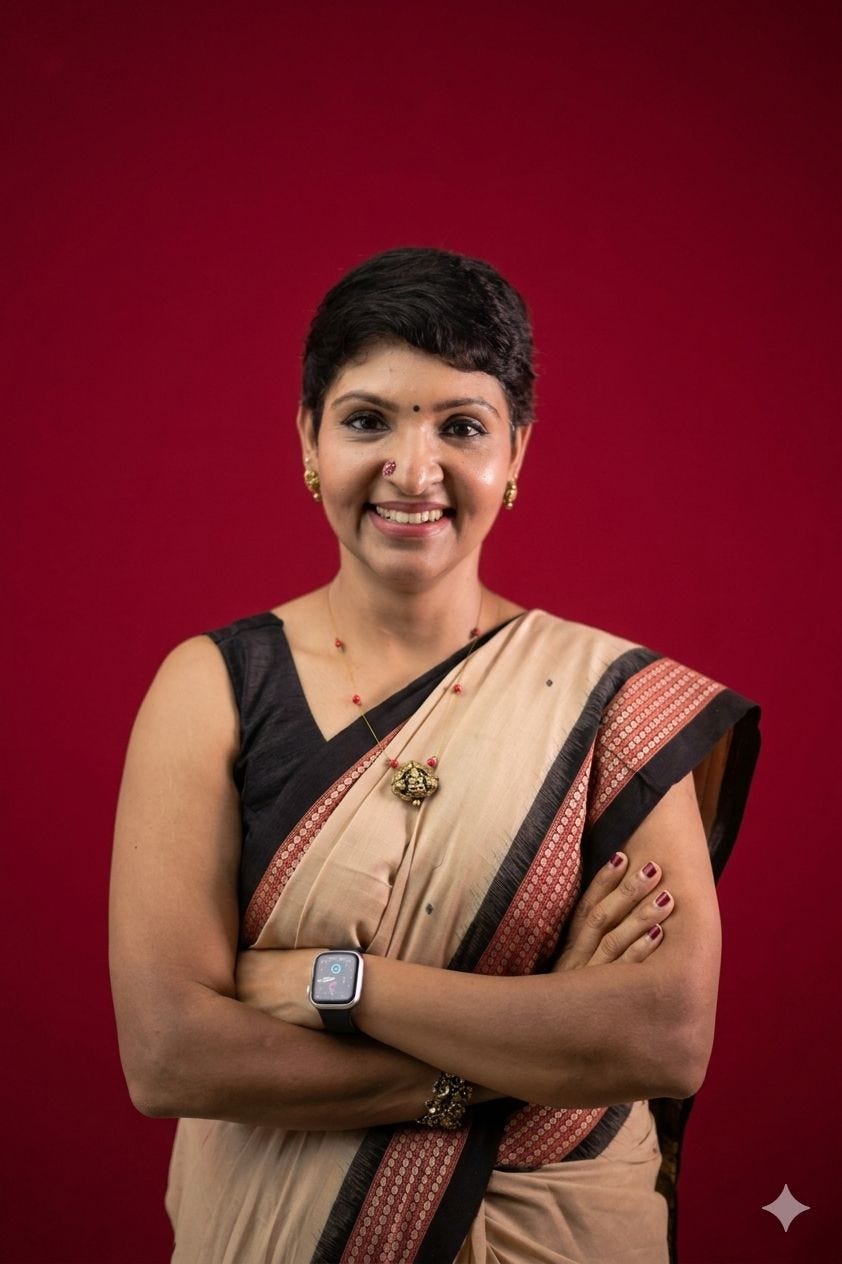
What was happening in your own body and life that pulled you towards strength training and menopause-specific nutrition?
My journey into this work became personal before it became professional.
Although I had studied Nutrition and Dietetics and spent years helping women with weight management and lifestyle change, I eventually began experiencing changes in my own body that made me realize that the strategies we often give women are not always designed for the bodies they have at different stages of life.
As I entered my forties, I started noticing changes in my energy, body composition, recovery, and overall relationship with my body. It made me ask a different question. Instead of constantly asking, “How can I lose weight?”, I began asking, “How can I become stronger?”
Strength training became a turning point for me. It shifted my focus from making my body smaller to making it more capable.
That experience led me deeper into understanding perimenopause and menopause. I realized that women in this phase need far more than generic weight-loss advice. They need support that considers their changing body, strength, muscle and bone health, sleep, stress, emotional wellbeing and, most importantly, the realities of their everyday lives.
Why can “eat less and move more” be unhelpful during perimenopause and menopause?
The problem with “eat less and move more” is not that nutrition and movement don’t matter. They absolutely do.
The problem is that the advice is often too simplistic for a complex stage of life.
During perimenopause and menopause, women may experience changes in body composition, appetite, sleep, recovery, and energy. At the same time, maintaining muscle and bone health becomes increasingly important.
So when a woman responds to weight gain by eating less and less or doing excessive cardio, she may find herself trapped in an approach that is difficult to sustain and does not adequately support strength, recovery, or overall well-being.
I encourage women to move away from asking, “How little can I eat?” and instead ask:
“How can I nourish, strengthen, and support the body I have now? How can I eat as much/as well as I can to support my changing body’s needs while going after my goals?”
For many women, that means adequate nutrition, sufficient protein and fiber, strength training, regular movement, good sleep, stress management, and habits that can be maintained for years — not just until the weight comes off.
Why is lifting weights so critical for women in midlife?
The goal in midlife should not simply be to weigh less. It should also be to remain strong, capable, and independent for the decades ahead.
Strength training can help women focus on building and maintaining physical capacity. I often tell my clients that strength gives you options — the ability to move confidently, carry things, travel, play with children and grandchildren, and continue participating fully in life.
There is also a powerful psychological shift that happens when a woman realizes she can do something she previously thought was impossible.
She lifts a heavier weight.
She performs her first push-up.
She feels her body becoming stronger.
And suddenly, she begins to see herself differently.
That is why strength training, in my work, is not just about exercise. It is also about rebuilding confidence and self-trust.
What does realistic, sustainable nutrition look like for South Asian women?
It has to look like real life.
Many South Asian women are cooking for an entire household while managing careers, children, ageing parents, and countless other responsibilities. Giving them a separate diet with unfamiliar foods and expecting them to prepare multiple meals every day is rarely sustainable.
I prefer to help women work with the foods and traditions they already have.
That might mean learning how to build more balanced meals, understanding portions, increasing protein and fiber, planning ahead, and developing the skills to navigate travel, restaurants, festivals, and family celebrations.
There is room for rice. There is room for dosa. There is room for biryani and celebration.
The goal is not to remove culture from food. The goal is to help women enjoy food without fear, guilt, or the feeling that they have lost control.
How connected is emotional and stress eating to the pressures South Asian women carry?
In my experience, they can be deeply connected.
Many South Asian women have spent years being caregivers, putting the needs of children, partners, parents, families, and work ahead of their own. There can be a tremendous amount of invisible labour and very little space left for themselves.
Food can then become comfort, reward, relief, or sometimes simply a moment of escape.
That is why telling someone to simply “stop emotional eating” rarely addresses the real issue.
We need to understand what food is doing for that person.
Is it comfort? Relief? A break? Pleasure? A way of coping with stress?
When women develop other ways to regulate stress and emotions and begin giving themselves permission to have needs of their own, their relationship with food can begin to change.
How do PCOS, thyroid issues, and blood pressure complicate midlife health?
Many women enter midlife already managing conditions such as PCOS, thyroid disorders, hypertension, or other metabolic concerns. At the same time, they may also be experiencing the changes associated with perimenopause and menopause.
This can create a confusing picture, with symptoms such as changes in weight or body composition, fatigue, disrupted sleep, mood changes, and altered energy levels.
One of the challenges is that women are sometimes given fragmented advice — one approach for weight, another for menopause, and another for an existing health condition.
PCOS & Perimenopause: What South Asian Women Need to Know

There is a conversation about PCOS that most South Asian women have never had.
I believe the woman needs to be seen as a whole person.
My role as a midlife and menopause coach is to help women build the knowledge, skills, and sustainable habits to better support their health alongside appropriate medical care. That includes learning how to nourish themselves, move and build strength appropriately, prioritise sleep and recovery, manage stress, and adapt their habits to their changing body and real-life environment.
Ultimately, my goal is not to give a woman another plan she has to depend on forever. It is to help her develop the skills and self-trust to take care of herself for life so she can move through midlife with greater health, strength, energy, confidence, and the capacity to thrive in every role she chooses to play.
What would you say to a woman who believes midlife weight gain is simply her new normal?
I would tell her: you don’t have to panic, but you don’t have to resign yourself either.
Your body changing does not mean you have failed. And it does not mean you are powerless.
What may have worked in your 20s or 30s may no longer be the best approach for the body you have now. Repeated dieting, extreme restriction, skipping meals, or excessive exercise may simply leave you exhausted and frustrated.
Sometimes the answer is not to try harder. It is to try differently.
Instead of focusing only on becoming smaller, I encourage women to focus on becoming stronger, better nourished, more rested, and more capable.
When we stop constantly fighting the body and start learning how to support it, meaningful change can become possible.
How do you help women rebuild their relationship with food without losing its cultural meaning?
Food is never just food.
For many South Asian families, it represents love, celebration, hospitality, memories, and connection.
I would never want a woman to feel that she has to reject her culture in order to become healthy.
The work is about moving away from fear and restriction and towards awareness and choice.
Can you enjoy a celebration without believing you have “ruined everything”?
Can you eat your favourite foods without feeling the need to punish yourself the next day?
Can you recognise whether you are physically hungry or emotionally overwhelmed?
Can you make conscious choices rather than reacting automatically?
That is what food freedom means to me. Not eating perfectly, but being able to enjoy food without food controlling your life.
Why are sleep and stress management so important?
Many women focus entirely on food and exercise while overlooking the fact that poor sleep and chronic stress can affect their energy, appetite, food choices, motivation, and ability to recover. Health behaviours don’t exist in isolation.
A woman who is exhausted is not necessarily lazy or lacking discipline. She may simply be depleted.
When women begin to prioritise sleep, recovery, and stress regulation, they often find they have more capacity to make and sustain the choices they were previously struggling with.
You cannot always solve an exhausted life by prescribing another diet or another workout.
Sometimes, the first step is to understand what the body and mind are asking for.
What is the first thing you’d want a woman who has tried every diet to understand?
I would want her to understand one thing:
You are not the problem.
If you have lost and regained weight repeatedly, it does not automatically mean you lack discipline, motivation, or willpower.
Many women have simply spent years following approaches that were never designed to be sustainable.
Before trying again, stop asking: “What is wrong with me?” Start asking: “What do I need to understand about the body and life I have now?”
You don’t need another cycle of restriction, guilt, and starting over.
You need skills.
You need an approach that works in your real life.
And perhaps most importantly, you need to rebuild trust in yourself.
Because the goal is not perfection. The goal is to become capable of taking care of yourself for the rest of your life.
For me, that is the deeper transformation: when a woman stops trying to shrink herself and starts building the strength, confidence, and self-trust to fully step into the next chapter of her life.
What I love about my conversation with Srividya is that she doesn’t ask women to wage war against their bodies.
She asks us to understand them.
To recognise that the body we have at 45 may need something different from the body we had at 25. To understand that nourishment isn’t punishment, movement isn’t a debt we owe ourselves after eating, and strength isn’t simply about how much weight we can lift. It is about having the physical capacity, confidence, and self-trust to participate fully in our own lives.
And I think her message to women who have spent years dieting is particularly powerful: you are not the problem.
Maybe you don’t need another diet. Maybe you don’t need to try harder. Maybe you need to stop starting over and begin learning how to care for yourself in a way that actually works for the woman you are today.
For South Asian women, there is another important layer to this conversation. Our food carries memory. It carries family, love, hospitality, celebration, and culture. Health doesn’t have to mean turning our backs on that. There is room for the rice, the dosa, the biryani and the celebrations. There is room for pleasure. There is room for culture. And there can also be room for greater awareness, nourishment and choice.
Because food freedom isn’t about eating perfectly. It is about being able to enjoy food without guilt, recognise what our bodies and emotions are asking for, and make choices without feeling that one meal has undone everything.
And perhaps that is the real transformation Srividya is inviting women into: moving from restriction to nourishment, from shrinking to strengthening, and from constantly questioning ourselves to trusting ourselves again.
Midlife doesn’t have to be the beginning of decline. It can be the beginning of a very different relationship with ourselves.
One where we stop asking, How do I become smaller?
And start asking, How do I become stronger for the life I still want to live?