


There are some conversations about menopause that begin quietly.
This is not one of them.
Imagine putting on a virtual reality headset and suddenly finding yourself inside someone else’s body. You can hear her thoughts. Feel her tension. Move with her. Experience the world through her eyes. Except this isn’t simply someone else’s body. It is Zoraan’s: a British-born Asian woman navigating menopause while the world around her is collapsing under the weight of climate crisis, digital surveillance, and the lingering legacies of colonial medicine.
You are not watching her story.
You are inside it.
That is the radical premise behind The Baby Factory Is Closed, the 20-minute single-player immersive VR experience written and directed by artist and filmmaker Deepa Mann-Kler and produced by Eva Robinson of Aura Digital Studios. The work places menopause firmly in the realm of rebellion rather than decline, using dark humour, surrealism and the cinematic energy of Bollywood to explore what happens when a woman’s body becomes a battleground for much bigger questions about power, identity and control.
The title itself is deliberately provocative. The Baby Factory Is Closed takes the language of fertility and turns it on its head, asking what happens when the part of a woman’s life that society has historically placed enormous value on comes to an end. What remains when reproduction is no longer the organising principle of a woman’s identity?
Quite possibly, everything.
On the project’s website, Zoraan is described not simply as the protagonist but as the world itself: her body, mind, muscles and memory becoming a living landscape that is monitored, medicated and overwritten by colonial, patriarchal and climate-driven systems of control.
And that is what makes this work particularly compelling for South Asian women.
For many of us, conversations about our bodies have never been entirely ours. There are the expectations around motherhood, marriage, appearance, ageing and respectability. There are the things we were taught not to say, the discomforts we learned to minimise and the bodily changes we were expected to simply endure.
The Baby Factory Is Closed asks what might happen if we stopped enduring quietly.
Meet Deepa Mann-Kler
Deepa Mann-Kler is a multi-award-winning artist, creative technologist and thought leader working at the intersection of storytelling, digital transformation, technical innovation, inclusion, ethics and creativity. She is CEO of Neon, StoryFutures Inclusion Executive Producer for CoSTAR and CDT AI, the UK Government-funded £75.6 million research network for creative technology, and a member of the UK Government Creative Industries Council. She is also Director of the Belfast XR Festival and Visiting Professor of Inclusive Innovation at Ulster University, as well as serving on the Euromersive Board and IDA XR Studio, and as a BAFTA Connect member.
Her work is driven by a belief that technology should not simply shape our futures, but that people, identity and community voice should have a say in what those futures look like. Her globally recognised XR work includes The Baby Factory Is Closed, which had its world premiere at SXSW 2026, alongside The Metaverse & Me and Discover ME, projects that explore identity, justice and the role of community in shaping immersive futures. Through her work, Deepa drives strategic XR projects designed to deliver social impact at scale.
A TEDx speaker whose talk, Being Human, explores some of these questions, Deepa regularly delivers keynotes on the intersection of storytelling, digital transformation, technical innovation, leadership, inclusion, ethics, bias, data, AI, design and creativity. Her work has received recognition across film, technology and immersive media, including selections and awards from the Royal Television Society, WinTech Series, Digital DNA, Global Shorts, Best Shorts Competition, Pinewood Lift Off Global Network, Delta International Film Festival, European XR Award, FIVARS, Indie Cine Tube Awards, Cornwall Film Festival and Dreamz Catcher International Film Festival.
And now, with The Baby Factory Is Closed, she is bringing many of those questions directly into the body of a menopausal South Asian woman, asking us to consider what happens when technology, culture, politics, identity and bodily autonomy collide.
Explore Deepa’s work: Neon | Deepa Mann-Kler | Belfast XR Festival
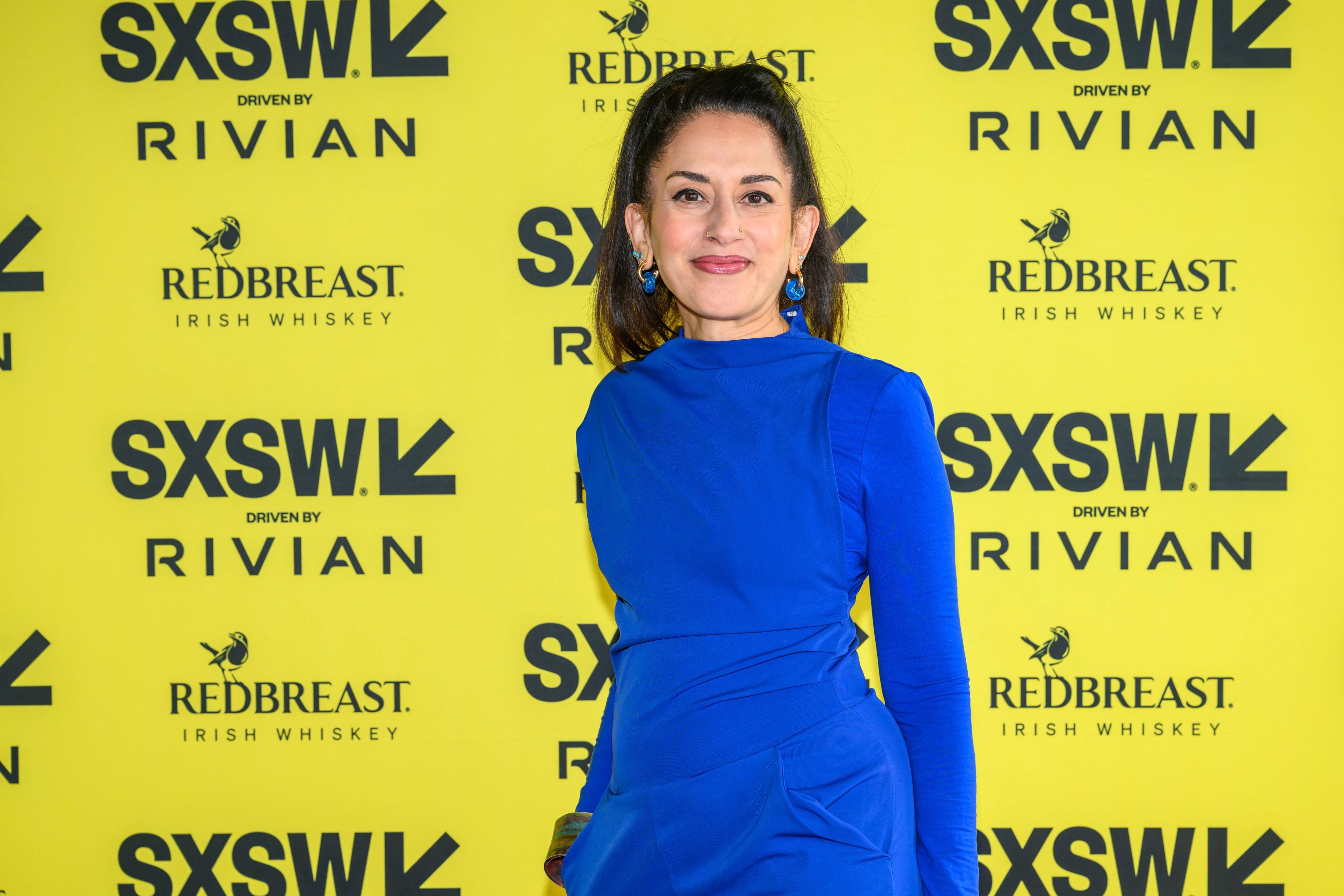
With The Baby Factory Is Closed, she turns that lens towards menopause, creating an experience that is deliberately visceral, political and deeply embodied.
The project premiered at SXSW in Austin in March 2026 and has since continued its journey through the immersive arts world.
Now, it is coming to London.
Menopause, but make it immersive
The technology is an important part of the story because this isn’t VR being used simply as a visual gimmick. Built in Unreal Engine 5, the experience combines real-time cinematic environments with motion capture, gesture-based interaction, biometric sensing, voice recognition and bio-haptic feedback. Original music and spatial sound design by Northern Irish composer Katie Richardson add another layer to the experience.
The result is deliberately multi-sensory. You don’t simply hear about Zoraan’s body. The intention is that you experience something of it.
The project’s own language is strikingly simple: you are not just in a game; you are inside a body.
And perhaps that is exactly what menopause needs more of: experiences that don’t ask women to stand outside themselves and clinically observe what is happening, but invite us to inhabit the experience, question it, and reclaim it.
An interview with Deepa Mann-Kler
We asked Deepa about rage, South Asian identity, fertility, bodily autonomy, and what she hopes women will take with them when they step back out of Zoraan’s world.
You describe The Baby Factory Is Closed as a story of menopause as rebellion, rather than menopause as decline. Why did you feel rage, rather than acceptance, was the right emotional language for this story?
Deepa: I was interested in rage because we are so often encouraged to accept what happens to our bodies quietly. Menopause is still framed through loss, a loss of fertility, youth, desirability and even relevance. I wanted to completely disrupt that narrative. Zoraan’s rage is not destructive; it is clarifying. She begins to recognise the systems that have told her how to behave, how to age, and how to understand her own body, and she refuses to comply. There is something incredibly powerful about that refusal. For me, the menopause became the perfect metaphor for rupture, the moment when acceptance ends, and rebellion becomes possible. Also in researching the work, I became fascinated by how different cultures understand the transition that the menopause brings. In Japan, konenki can be understood as a period of renewal and an alternative stage of life, rather than simply decline. By contrast, the Western narratives can over-medicalise the menopause, reinforcing a stigma around ageing, fertility and women’s bodies.
Zoraan is a British-born Asian woman navigating menopause against a backdrop of climate collapse, digital surveillance and the lingering legacies of colonial medicine. What does it mean to place a South Asian woman’s menopausal body at the centre of these much bigger political and cultural questions?
Deepa: It was really important to me that Zoraan was a British-born South Asian woman because our bodies are rarely placed at the centre of speculative futures. Too often we are peripheral to these stories, rather than the person through whom the world is understood. Zoraan’s menopausal body becomes a battleground where much bigger systems collide: patriarchy, colonial medicine, AI surveillance, climate collapse and cultural expectations around women and ageing. There is also something very specific about being a South Asian woman negotiating Western medicine, alongside inherited cultural ideas about the body, duty, shame and silence. I wanted to make those tensions visible, but not make Zoraan a victim of them. She is funny, angry, contradictory and powerful. Her body becomes the place from which she questions those systems and ultimately refuses to comply.
The choice of Zoraan matters. This isn’t a generic story about menopause detached from culture, history or identity. The project’s framing is explicitly rooted in a South Asian feminist perspective, bringing together dark humour, surrealism and Bollywood energy with questions around control, autonomy and resistance.
For many South Asian women, the body has never entirely belonged to us. There are expectations around how we look, behave, mother, age, and even how loudly we are allowed to express discomfort. What are you hoping women will recognise, question or reclaim when they step inside Zoraan’s body?
Deepa: I hope women recognise something of themselves in Zoraan, but also question who taught us the rules we live by. For many of us South Asian women, the body can become communal territory, shaped by family, culture, religion, medicine and expectations around respectability, motherhood and ageing. Even discomfort can become something we are expected to carry quietly. By literally placing the audience inside Zoraan’s body, I wanted to disrupt that. Her body is being monitored, judged, and controlled, but it is also where resistance begins. We also have an AI character called Aunty Intelligence, who is acerbic, cutting, and always ready to offer advice, particularly when it hasn’t been asked for. This is also an example of how women can sometimes reinforce and perpetuate the very patriarchal systems that constrain them. Ultimately, I hope women come away thinking about what belongs to them: their anger, pleasure, choices, voice, and body. Zoraan does not ask permission to reclaim herself. That refusal is central to the work.
Menopause has been one of the most liberating experiences of my life. I am now 57; I love my life, and I am far less willing to put up with nonsense. I speak out more; I am braver. There is an extraordinary freedom that comes with this stage of life. For me, the menopause has not been about becoming less; it has been about becoming more fully myself.
This question feels particularly important because the experience doesn’t present Zoraan as passive. She is described as volatile, funny, and furious; her body becomes both battlefield and birthplace for resistance.
There is something powerful about that shift in language. The menopausal body isn’t presented as something broken that needs fixing. It is a body in transition, a body with history, a body that has been controlled and scrutinised, but also a body capable of pushing back.
There is something wonderfully provocative about calling it The Baby Factory Is Closed. Beyond the humour, what does that title say about the way women are often valued through fertility and motherhood, and what happens to a woman’s sense of identity when that chapter closes?
Deepa: The title is deliberately provocative and funny, but beneath that humour lies a serious question about how women’s value has historically been linked to fertility, motherhood, and reproduction. The phrase “baby factory” reduces the female body to its biological function, which is precisely what the work is pushing against. When that function ends, what happens next? I wanted the answer to be freedom rather than loss. Zoraan is not disappearing because her reproductive years are over; she is becoming more powerful, more vocal, and less willing to conform. There is something wonderfully disruptive about saying, the baby factory is closed, but I am still here. My body is not redundant. It belongs to me, and perhaps for the first time, I get to decide what happens next.
Buddhism teaches us that change is constant, and I really believe that. We go through significant transitions throughout our lives: periods, pregnancy, childbirth, menopause. For me, what matters is our mindset and how we choose to look after ourselves through those changes. During menopause, I gave up alcohol and meat, cut out sugar, and started exercising more. Those changes had an immediate and profound impact on how I felt. Menopause made me think differently about my relationship with my body and what it needed from me at this stage of my life.
The title is funny until you sit with it for a moment, then it becomes uncomfortable. And perhaps that is exactly the point.
What happens when the biological function around which so much of a woman’s social value has historically been constructed is no longer available? Does something disappear?
Or does the woman finally get to ask who she is when she is no longer being measured through what her body can produce?
Your work tells women who have been told to calm down, smile more, or stay quiet: this experience is for you. If a woman walks out of the VR experience feeling angry, liberated, uncomfortable, or even seen in a way she hasn’t felt seen before, what would you hope that feeling makes possible in her own life?
Deepa: I hope it gives her permission. Permission to be angry, to take up space, to question what she has been told about her body, her value, and how she should behave. We spend so much of our lives being conditioned to accommodate other people, to make ourselves smaller, quieter, and easier. I would love a woman to leave The Baby Factory Is Closed feeling that she does not have to do that anymore. Feeling seen matters, but for me the next question is, what do you do with that feeling? Maybe you speak up when you would previously have stayed silent. Maybe you say no. Maybe you make a different choice. Liberation does not have to be dramatic. Sometimes it begins with simply deciding that your life and your body belong to you. Anything is possible. We do not have to be defined by who we were when deciding who we want to become. There is enormous freedom in caring less about what other people think and becoming more confident in your own choices. But I also believe community is incredibly important. Liberation is not just an individual act; it comes from finding people who support you, challenge you, and allow you to be fully yourself. For me, this stage of life is about possibility, being braver, letting go of expectations that no longer serve us, and recognising that we still have the power to reinvent ourselves.
And sometimes the most radical act of freedom is simply to dance, in your own body, on your own terms.
That invitation to feel something matters. Because perhaps we have become so accustomed to talking about menopause through symptoms, treatment and management that we have forgotten there is another conversation underneath it all.
Who gets to define our bodies? Who gets to decide what ageing means? Who gets to tell us how we should feel about becoming older? And what might happen if women stopped apologising for the answers?
See The Baby Factory Is Closed at the V&A
The Baby Factory Is Closed will be presented at the V&A South Kensington as part of Digital Design Weekend 2026, which runs from Friday 18 to Sunday 20 September 2026. The weekend brings together artists and designers exploring the intersection of art, design and technology, with this year’s programme looking particularly at how creative technologies are reshaping our relationships with ecology, care and community.
The experience is included among the V&A’s Show & Tell and installations programme alongside a range of contemporary digital artworks. The event is free and operates on a drop-in basis, although places are first come, first served and individual activations may reach capacity.
The experience itself comes with accessibility and sensory guidance, including information around VR, haptic feedback, scent, flashing lights, enclosed spaces and motion sensitivity. A seated version is also available for people with restricted leg movement.

Find out more about The Baby Factory Is Closed | See the V&A Digital Design Weekend programme
The factory may be closed. The conversation is only beginning.
There is something deliciously subversive about taking a life stage so often framed through loss and asking us to look at it through another lens.
Not decline, invisibility, or the end of relevance, but rebellion.
The Baby Factory Is Closed doesn’t promise a comfortable journey. In fact, it seems determined to do the opposite. It asks us to enter the discomfort, inhabit the body, confront the systems that have shaped it, and perhaps come out the other side asking better questions.
Because menopause isn’t simply something that happens to women’s bodies; it happens within cultures, families, healthcare systems, workplaces, relationships, and histories.
And sometimes, reclaiming the conversation begins with refusing to whisper.
The baby factory is closed. But perhaps this is where the real story begins.