


A grandmother’s hands, unhurried, working through long hair on a Sunday morning. The sound of a language that lives somewhere between the tongue and the chest, not quite fluent, but deeply felt. The particular comfort of a meal that requires no translation, no explanation, no apology for what it is.
These are the things South Asian women carry with them. Into their forties and fifties. Into the doctors’ offices and the HR departments and the family gatherings and the quiet rooms where they sit alone with a body that is changing, a self that is shifting, and a question that no one around them seems to be asking.
Who am I in this season of life? And does any of this, my heritage, my culture, my history, have anything to say to me here?
South Asian Heritage Month 2026 invites us to explore Unity in Diversity, a theme that celebrates the extraordinary breadth and richness of South Asian communities across eight countries, hundreds of languages, multiple faiths, and millennia of intertwined histories. It asks us what unites us across those differences. It asks us what we carry together that we might not always name.
At The Sattva Collective, we have been sitting with that question since before we had a name for it.
The diversity we celebrate, and the unity that holds it
South Asia is not one thing; it never has been.
The South Asian women who make up The Sattva Collective’s community come from India, Pakistan, Bangladesh, Sri Lanka, Nepal, and the diaspora that has woven South Asian heritage into the fabric of British life over generations. They are Hindu, Muslim, Sikh, Christian, Jain, and secular. They speak Punjabi, Gujarati, Urdu, Tamil, Hindi, Bengali, Konkani, and English. They are mothers and grandmothers and daughters and women who have built careers and businesses and families and lives in the UK, far from the places their families first called home.
They are not one community; they are many. And yet, when a South Asian woman in her forties sits down in a Sattva Women’s Circle, something happens that transcends every one of those differences. She recognises something in the woman sitting across from her. In the way she pauses before she speaks. In the particular silence she carries. In the way she holds her exhaustion, carefully, privately, as if it belongs only to her.
That recognition is the unity. Underneath all the diversity of faith, language, background, and generation, the shared experience of being a South Asian woman in midlife in the UK, navigating a transition that the culture has never quite learned to hold.
That is what unites us. And it is why The Sattva Collective exists.
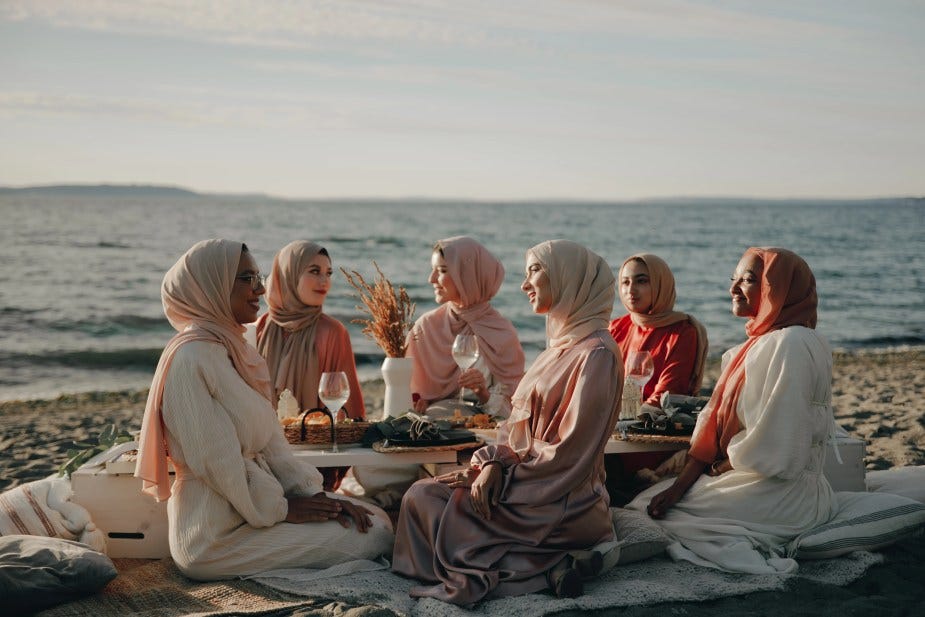
What our heritage carries, and what it costs us
South Asian heritage is extraordinary in its richness: its food, its textiles, its music, its languages, its philosophies, its medicine, Ayurveda and Unani, centuries-old systems of healing that are only now beginning to receive the recognition they have always deserved in Western contexts. Its family structures are rooted in deep interdependence and collective care. Its festivals, its rituals, its architecture of belonging.
We carry all of this. And for South Asian women in midlife, it is both a gift and a burden.
The gift is community, connection, the understanding that you are not navigating life alone, that there are people who will show up, that the bonds of family and culture hold. The gift is food as love, celebration as healing, ritual as anchor. The gift is a philosophical heritage, from the Sanskrit concept of sattva, meaning clarity and balanced energy, to the Sufi traditions of many South Asian Muslim women, to the Sikh teaching of sewa, selfless service, that offers a depth of wisdom about what it means to age with grace, purpose, and surrender.
The burden is the expectation of endurance. The cultural conditioning that says South Asian women are strong, and strong women do not complain. The family structures that place women at the centre of care: for children, for ageing parents, for husbands, for in-laws, without always asking what those women need in return. The silence around the body, around health, around the changes of midlife and menopause leaves women navigating enormous physical and emotional upheaval entirely alone.
Unity in Diversity for South Asian women in midlife means holding both truths simultaneously. Honouring what our heritage gives us, and being honest about what it asks of us.
The healing that heritage offers
There is something happening across South Asian women’s communities that feels significant: women are returning. Not to everything, not to the expectations that diminished them, not to the silence that hurt them, not to the roles that left no room for their own needs. But to the wisdom, to the rituals, to the parts of their heritage that were always about nourishment, not performance.
Women in midlife are returning to Ayurveda, discovering in its ancient understanding of the body’s seasons and doshas a framework for the changes they are experiencing that Western medicine has never quite given them. They are returning to the practice of oil, coconut, sesame, mustard, not as something to be ashamed of, but as medicine. They are returning to the spices in their kitchens and beginning to understand them as anti-inflammatory, adaptogenic, and hormonally supportive. They are returning to the concept of rest as sacred, not lazy.
They are returning to each other, gathering in rooms, in circles, in WhatsApp groups, on Substack, and in community spaces, doing what South Asian women have always done when they gather without an audience: telling the truth.
At The Sattva Collective, we see this return every month. In the Sattva Women’s Circle, women arrive carrying everything: the hormonal shifts, the identity questions, the caregiving exhaustion, the grief of ageing parents and changing relationships and selves they no longer recognise. And they find, in a room full of other South Asian women, something they weren’t sure still existed. Understanding. That doesn’t require translation.
That is heritage. Not the version that asks women to be silent, but the version that has always known how to hold a woman when she is falling apart, and help her find her way back.
Unity in Diversity: What it means to us
The Sattva Collective was founded on the belief that South Asian women deserve a midlife and menopause conversation that truly understands them. Not a conversation that flattens our differences, that treats all South Asian women as the same, speaks to us as a monolith, ignores the profound distinctions of faith, language, generation, and experience that make us who we are.
But a conversation that holds us together in our diversity. That says: your specific experience matters, and so does hers, and so does the woman across the room whose background is nothing like yours but whose exhaustion feels exactly the same.
Unity in Diversity, for us, means building a community where a Punjabi grandmother navigating hot flushes in silence and a British-born Bangladeshi woman questioning her marriage and a Tamil professional burning out at work and a Pakistani woman caring for her mother while her own body changes, can all find themselves in the same room, recognised, not erased.
It means understanding that the silence around midlife and menopause is a shared inheritance, across South Asian communities, across faiths, languages and generations. And that breaking it is a shared act. One that belongs to all of us.
South Asian Heritage Month 2026: How to mark it
South Asian Heritage Month is observed throughout July 2026 under the theme “Unity in Diversity.” This year, it moves to a full calendar month, 1 to 31 July, making it easier than ever to participate, plan, and mark the month in a meaningful way.
Here is how The Sattva Collective community can engage:
Submit your story to the SAHM National Heritage Archive: a personal reflection, a family memory, a community narrative. In any language, any format. Your story belongs there. Submit at southasianheritage.org.uk/how-to-submit-your-stories
Find or list an event on the SAHM national calendar. If you are hosting a gathering, a talk, or a community event for South Asian women in July, list it for free. Events at southasianheritage.org.uk/events-list
Join The Sattva Collective’s Sattva Women’s Circle: our monthly in-person gathering for South Asian women in midlife. July’s circle falls during South Asian Heritage Month, and we will be holding space for exactly this conversation: what our heritage gives us, what it asks of us, and what it means to navigate midlife as South Asian women in the UK today. Find out more →
Share this article with a South Asian woman in midlife who needs to feel less alone. With your family WhatsApp group. With a colleague who doesn’t know this conversation is happening. Every share reaches a woman who might need it.
A final thought
In Sanskrit, the word sattva speaks to clarity, purity, and balanced energy. It is the quality of inner light, the stillness that exists beneath the noise and change of any season of life.
It is not a quality that belongs to one faith tradition, or one country, or one generation. It is a human quality. One that every South Asian woman, across all the extraordinary diversity of who we are and where we come from, carries within her. South Asian Heritage Month is a reminder that we carry it together.
And midlife, with all its difficulty, its disruption, its grief and its invitation, is when we may need that reminder most.
To every South Asian woman navigating midlife this July: your heritage is not a burden, it is a source. And you are not navigating this season alone.