


There are losses that everyone can see. The funeral. The black clothes. The social media post. The flowers and the phone calls.
And then there are the losses that don’t have a name in our everyday language. The parent who is still alive but no longer knows your name. The homeland you left decades ago, that no longer exists in the way you remember it. The younger version of you who will never return, the one who could run up the stairs without thinking, or believe that life would follow a neat plan.
For many South Asian women in midlife, grief doesn’t arrive as one clean event. It comes in layers, like waves, quiet, delayed, often unacknowledged.
You keep functioning. You cook. You attend weddings. You send “So sorry for your loss” messages in family groups. You book flights home and back again.
On the outside, you look “strong”. Inside, something is shifting that you don’t quite have words for.
Let’s talk about that.
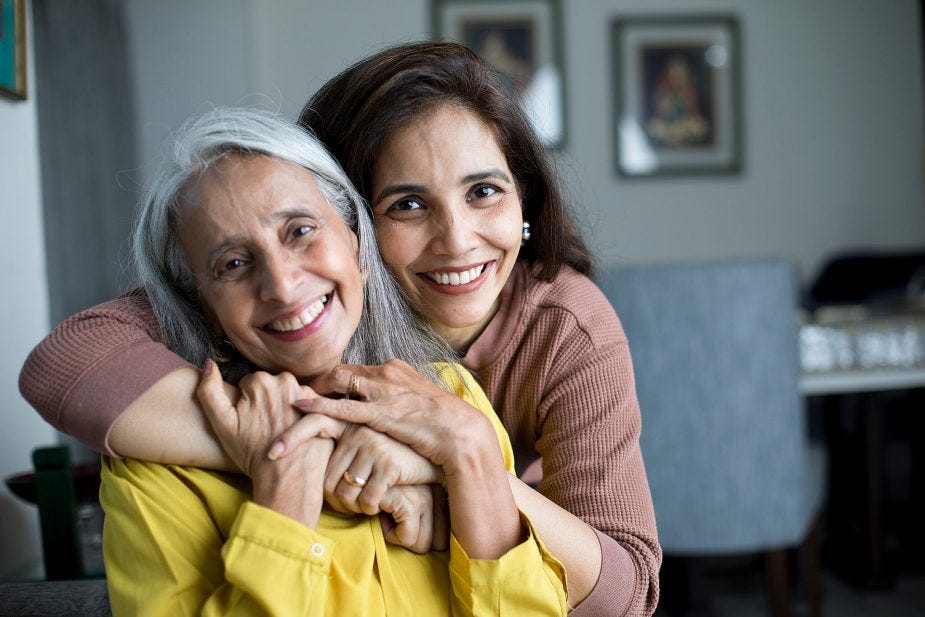
Grief isn’t always a moment. Sometimes it’s a landscape.
We’re taught to think of grief as something that happens when someone dies. You cry. You do the rituals. You go back to work. Life moves on.
But in midlife, grief is rarely that simple. It can look like:
Watching a parent slowly lose their memory, mobility, or independence
Seeing the house you grew up in being sold or demolished
Realising your children no longer need you in the old ways
Sitting with a health diagnosis that quietly rearranges the rest of your life
Letting go of a marriage or identity that you fought to sustain for years
You may not even call it grief. You might call it:
“Feeling off.”
“Being emotional lately.”
“Just tired.”
“Having a midlife crisis.”
Here’s what’s actually happening: Parts of your life are ending. Parts of you are changing. And your heart is trying to catch up.
Grief isn’t just tears. It’s the ache that rises when reality doesn’t match what you hoped, expected, or were promised.
When parents age, decline or die “back home”
For many in the diaspora, there is a very specific kind of pain: You’re here. They’re there. Your parents’ hair gets whiter over video calls. Their faces look thinner. They talk more about hospital appointments and less about festivals.
You book flights when you can. You send money if needed. You coordinate with siblings across time zones. Your phone becomes a lifeline and a source of constant dread.
The questions creep in:
“Will I make it in time if something happens?”
“Did I do enough? Am I doing enough?”
“What if they go before I can visit again?”
And when the call eventually comes, or when the slow decline becomes irreversible, you’re hit with two levels of grief:
The grief for your parent, as their child.
The grief of a daughter who wasn’t physically there in all the ways she wanted to be.
This second grief is laced with guilt, even when you know logically you did your best.
You might find yourself thinking:
“If I had stayed in that country… If I had visited more often… If I hadn’t waited for the ‘right time’ to go…”
But the reality is, you’ve been living between worlds for years. And that comes with impossible choices.
Grief without rituals, or rituals at a distance
In many South Asian cultures, death and grief are held by ritual. We gather. We cook. We sit on the floor. We wear certain colours. We pray. We recite. We mark specific days. There is a structure, a script to move through, even when you’re numb.
Diaspora grief often disrupts this.
You watch parts of the funeral on a live stream.
You can’t attend the full mourning period because of work, visas, school holidays, or finances.
You sit alone in a flat thousands of miles away while people gather in your family home.
You return “home” and feel like a guest in a house you grew up in.
So your body holds grief with nowhere to put it. No formal goodbye. No shared weeping. No neighbours coming in and out with food and stories.
You go back to “normal life” faster than your heart can understand. You’re answering emails when you should still be sitting with your loss. You’re cooking dinner when you want to scream. This isn’t because you’re cold or “strong”. It’s because the structure grief is meant to move through has been disrupted.
Losing homelands that still exist on the map
There’s another quiet grief many midlife South Asian women carry: The grief for a place that technically still exists, but no longer feels like yours. You may have left as a child, teenager or young adult. Back then, you assumed “home” would stay frozen in time: The same house. The same smells. The same neighbours, shops and festivals.
Then you go back years later and find:
High-rises where there were once fields
New languages, new accents, new politics
Relatives you barely recognise
Young people who call you “Aunty” and laugh at your old slang
You realise the place you’ve been homesick for lives mostly in your memory. You’re a stranger in the country on your passport and a visitor in the country in your heart. That in-between space can ache.
You might find yourself mourning:
The simplicity of childhood routines
The sense of belonging you once took for granted
The version of yourself who knew exactly where she came from
It can feel dramatic to call this “grief” when nothing catastrophic has happened. Yet your body knows: something has been lost.
Midlife: when old selves start to fall away
As if parents and homelands weren’t enough, midlife often asks you to let go of parts of yourself, too.
You may quietly be grieving:
The body you once had. Not from vanity, but from remembering what it felt like to live without joint pain, hot flushes, fatigue or constant planning around your cycle.
The role you once played. The dependable daughter, forever-available mother, “strong one” in the family, worker who never took sick days.
The dreams that won’t happen now. Certain careers, relationships, timelines for having children or grandchildren, financial goals, travel fantasies, lifestyle visions.
No one throws a ceremony when you let go of these things. There’s no official goodbye to the 25-year-old you thought you’d become. But you feel it.
In the quiet moments, a question rises:
“If I’m no longer her… who am I now?”
That’s grief, too. It’s the grief of outgrowing an old identity.
Why grief hits harder in midlife
Grief at 45 is not the same as grief at 18. At 18, loss is often your first big collision with mortality. At 45, 50, 55… It’s layered on top of everything you’ve already carried.
Midlife grief can feel heavier because:
You’re often dealing with multiple losses at once: health, parents, career shifts, children leaving, menopause, and marriage changes.
You’ve become the “older generation” without realising when it happened.
You’re grieving forward as well as backward, not just who/what you’ve lost, but what won’t be possible in the time left.
And still, the world expects you to:
Show up to work
Run households
Support everyone else emotionally
Smile at social events
Reply to messages within a reasonable time
No wonder your heart feels full, and your body feels tired.
Making space for grief when life doesn’t stop
You might be thinking, “All of this is true… but I don’t have the luxury to fall apart. People need me.” Fair. Life rarely pauses for our hearts. But there is another way. Instead of a dramatic breakdown, think of grief as something that needs regular, gentle attention. You can create pockets of space, even in a full life.
A few ideas:
1. A weekly grief walk
Choose one short walk each week where you deliberately let yourself think about what you’ve lost. No podcast. No phone. Just walking and feeling. If tears come, let them. If numbness comes, notice it. If nothing comes, that’s okay too. The point is to give grief a time and place.
2. A remembrance corner or altar
It doesn’t need to be elaborate or religious if that’s not your thing. A photo, a candle, a small object that reminds you of a person or place. Somewhere to sit for 5–10 minutes when you miss them, instead of pushing them aside.
3. Letters you never send
Write to:
The parent who died before you could say all you wanted
The younger self you’re mourning
The homeland you still dream of at night
Tell them what you miss, what you wish had been different, what you’re grateful for, what still hurts. You don’t have to show anyone. Writing gets the ache out of your body and onto paper.
Creating your own rituals when traditional ones aren’t possible
If distance, logistics or family dynamics mean you can’t participate fully in traditional rituals, you’re allowed to create your own.
You might:
Cook your parents’ favourite dish on their birthday every year and share it with someone who knew them, or eat it alone and remember.
Light a candle or diya once a week and sit in silence for a few minutes, dedicating that time to them.
Visit a place in your city that reminds you of your homeland, a shop, a park, a temple, a café, and treat it as a small pilgrimage.
Play a song they loved, or music from “back home”, and let yourself feel whatever comes.
Ritual is just a repeated action with meaning. You’re allowed to create new ones that fit the life you’re actually living.
When others don’t understand or won’t talk about it
One of the most painful parts of grief in our communities is the silence.
You might hear:
“Be strong.”
“They had a good life.”
“At least they’re not suffering now.”
“Don’t cry, they won’t rest in peace if you cry.”
People mean well. But platitudes can make you feel even more isolated.
Or you might find that:
Siblings grieve differently and seem “cold” or “too emotional” to you
Friends change the topic because they’re uncomfortable
You’re expected to “move on” faster than you can
If that’s your reality, please know: There is nothing wrong with you for still feeling heavy months or years later. “Still crying” does not mean you’re stuck. It often means you finally have enough safety to feel what you couldn’t before.
You may need to look for understanding beyond your usual circles:
A therapist, especially one who understands cultural context
A grief support group
One or two friends who can handle depth, not just small talk
You are not a burden for needing to talk about the people and places you’ve lost.
Gentle journaling prompts for grief in midlife
If you’re not sure where to start with all of this, these prompts might help:
Who or what am I grieving right now, even if I haven’t called it grief? (People, places, health, roles, dreams, identities.)
What did I need and not receive at the time of the loss? (Time off, validation, someone to sit with me, clearer information, ritual, touch.)
What guilt am I carrying that might not actually be mine to carry? If a friend told me the same story, would I see it differently?
What tiny ritual or practice could I create to honour what I’ve lost? (A weekly walk, a candle, a photo, a prayer, a playlist, a letter.)
In what ways has this grief changed me? What has softened? What has hardened? What do I see more clearly now?
If my loved one could speak to me now, what would I want them to know about how I’m living? And what might they gently want for me?
Let your answers be imperfect. Grief doesn’t need tidy sentences; it needs honesty.
Letting grief be part of your story, not the end of it
You will never “get over” certain losses. That’s not the point. The parent you loved, the home you left, the self you once were, they’re woven into you. What changes over time is the weight and the shape of the grief.
At first, it’s all-consuming. It wakes you in the night. It blindsides you at traffic lights, in supermarkets, during adverts, and at weddings. Then slowly, quietly, it becomes something you carry alongside your days. Still heavy sometimes, but not the only thing in your hands. This is not betrayal. It’s not forgetting. It’s life insisting on continuing, even when part of you didn’t want it to.
You’re allowed to:
Laugh again without feeling guilty
Plan for the future without feeling disloyal
Rearrange your life around who and what remains
Let joy, love and curiosity sit next to sorrow at the same table
Grief in midlife is not a problem to solve. It’s a language you learn to live with. You will always miss what you’ve lost. But you are still here. Still breathing. Still capable of meaning, beauty, connection, surprise.
The love you carry for parents, homelands and old selves doesn’t vanish. It reshapes itself into how you live now, how you care, how you create, how you show up for the life that’s left.
You don’t have to be “over it”. You just have to keep finding gentler ways to walk with it x
The post Grief in Translation: Losing parents, homelands and old selves in midlife appeared first on THE SATTVA COLLECTIVE.