


There’s an image many of us grew up with: A “good life” looks like a full house. Husband. Children. In-laws dropping in. Guests. Noise. A woman at the centre of it all, cooking, hosting, holding everything together.
Living alone?
That was for:
students between house shares
men working abroad
people who hadn’t “settled” yet
Certainly not for South Asian women in their 40s, 50s, 60s. And yet… here you are. Maybe you’re divorced. Maybe you’re widowed. Maybe you chose not to marry. Maybe you’re still in a relationship but living separately. Maybe you left a home that was never really home to you.
However you arrived here, the fact is: You live alone now. And the world has opinions about that.
Let’s talk honestly about what it means to live alone as a South Asian woman in midlife, not as a tragedy, not as a failure, but as a very real, very valid way of living.
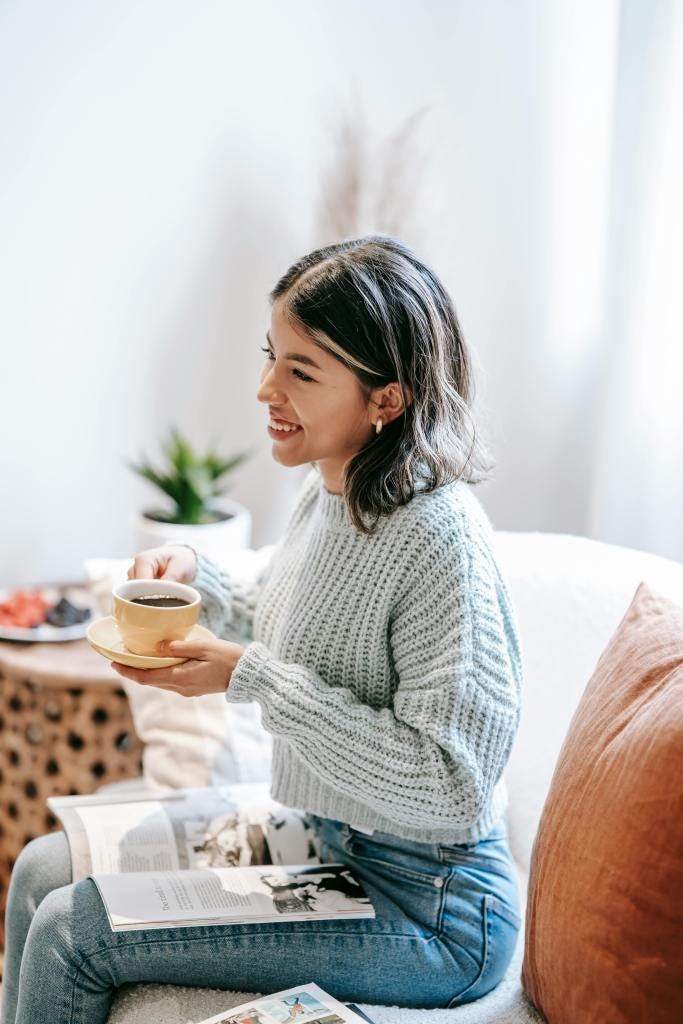
“Bechari” culture: when people pity a life you actually like
If you listen carefully, you’ll hear it. The pitying tone. The tilted head. The questions were dressed as concern:
“You manage… all by yourself?”
“Don’t you get scared at night?”
“Aren’t you lonely?”
“You must miss having someone there.”
Sometimes it’s less direct:
“If you ever need anything… You just call, okay?”
“You need someone to look after you.”
“You’re so brave.” (Translation: I can’t imagine this by choice.)
On the surface, it sounds caring. Underneath, there’s an assumption: That living alone is automatically sad. That a woman alone is incomplete. That a woman in her own space is waiting to be claimed, rescued, fixed.
What this really reveals is how deeply we’ve been taught to measure a woman’s life by who she lives with, instead of how she lives within herself.
How you actually got here (it wasn’t by accident)
Most midlife women living alone didn’t just “end up” there.
Behind this choice, there’s usually a history:
Years in a marriage where you felt unseen, unsafe or unloved
A partner’s betrayal that shattered not just trust, but your sense of home
The death of someone you built your whole life around
A conscious decision not to marry into dynamics that would have crushed you
A slow realisation that peace mattered more than appearances
Living alone, for many women, is not Plan B. It’s the first time in their life that their living situation truly reflects their inner truth. You might miss a partnership. You might still grieve what you hoped you’d have.
But don’t overlook this: It took courage to choose your own sanity, freedom and safety over keeping up appearances.
That is not something to be ashamed of. That is something to respect.
The real gifts of living alone (that no one tells you about)
Let’s name what’s actually beautiful about your life, even if others can’t see it.
1. Peace that doesn’t need permission
There is a kind of quiet that heals your nervous system:
No one is storming in with unpredictable moods
No walking on eggshells
No constant background criticism or commentary
You can:
Control the noise
Choose who enters your space
Decide when to talk and when to be silent
That’s not “selfish”. That’s what safety can feel like.
2. A home that finally looks and feels like you
You get to ask:
What colours make me exhale?
How do I actually like my bedroom to feel?
Do I want a TV in the living room or not?
Which objects tell my story, not just the family’s?
No more decorating for the imaginary guests. No more fighting for a corner that feels like your own. You can create a home that supports your real routines, rhythms and rituals.
3. Time that’s not constantly negotiated
You don’t have to:
Fit yourself around someone else’s moods or timetable
Justify how long you spend reading, bathing, journaling, working, resting
Ask permission to go out or stay in
You can go to bed at 8 pm or 1 am. You can eat dinner at 5 or at 10. You can have cereal for dinner and dal at breakfast if you feel like it. Is it glamorous? Not always. Is it yours? Completely.
The worries that keep you up at night (you’re not imagining them)
Let’s not romanticise it. Living alone as a midlife woman isn’t just candles and quiet mornings.
There are real concerns:
Safety: coming home late, answering the door, who knows you live alone.
Health: “What if something happens to me and no one knows?”
Finances: rent or mortgage on one income, bills, retirement, and emergencies.
Future: “Who will look after me when I’m older?”
These are not reasons to panic. There are reasons to be intentional. The goal is not to eliminate risk – that’s impossible. The goal is to create structures that help you feel more held in your solo life.
Building a life that holds you: four pillars for living alone in midlife
Think of four areas:
Safety
Support
Structure
Soul
1. Safety: your body and your home deserve to feel protected
A few practical steps can make a huge difference:
Home security
Good locks on doors and windows
Peephole or camera at the door
Curtains/blinds that don’t reveal your whole life to the street
Lights on timers if you’re away
Personal safety
Sharing your location with 1–2 trusted people when out late
A simple “I’m home” message to someone after evening journeys
Knowing your neighbours’ names (you don’t have to be best friends)
Health safety
Regular GP check-ups
Weeks of medication organised
A plan if you’re unwell, who you can call, and who can check in
This isn’t about living in fear. It’s about not leaving everything to chance.
2. Support: living alone doesn’t mean living without a village
You may not have a partner in the house. That doesn’t mean you have to do everything alone.
Ask yourself:
Who are my “emergency people”? (The ones I can message if I’m scared, stuck, or unwell.)
Who are my “ordinary day people”? (Those I can meet for coffee, a walk, a call just to feel human.)
You can intentionally cultivate:
One or two neighbours you can trust for small favours
A WhatsApp group with a few close friends for daily check-ins
A local faith/community group, book club, class, or walking group
You’re not being needy by wanting regular contact. Humans are wired for connection. Even the most introverted among us still needs to feel held by others in some way.
3. Structure: creating rhythm so the days don’t blur
One challenge of living alone is that time can become formless. No one is coming home at 6 pm. No one is asking what’s for dinner. No school run. No shared routines.
If you’re not careful, days can dissolve into:
late nights on your phone
erratic meals
long stretches of scrolling
You deserve better than that.
A gentle structure could include:
Morning anchor
Making your bed
Opening the curtains
Tea or coffee without your phone
5–10 minutes of journalling or stretching
Meal rituals
Even if it’s just you:Sit at a table sometimes, not always on the sofa
Use a proper plate, not always eating out of containers
Light a candle a few evenings a week, play soft music
Evening wind-down
A “tech off” time
Something that signals the end of the day: a shower, skincare, reading, prayer, reflection
Again, none of this has to be perfect. The point is to mark your own life as worth attention.
4. Soul: feeding the part of you that is more than roles
Living alone gives you an unusual opportunity: Your time and space are more in your control than ever before.
You can begin to ask:
What genuinely makes me feel alive?
What have I always wanted to explore but never had the space for?
What do I want to learn, create, and experience before I leave this earth?
You might find nourishment in:
Reading widely
Creative hobbies (writing, art, music, crafting, photography)
Classes (language, cooking, dance, yoga, philosophy)
Volunteering or community work
Spiritual or reflective practices
Your home can become a small sanctuary for your soul, not just a place you sleep.
Loneliness vs aloneness: being honest about the hard nights
Even if you love your solo life, there will be moments:
A bad dream and nobody beside you
A medical result, and no one in the house to debrief with
Festivals, weddings, and family events, where you come home to an empty flat
Nights when the silence feels heavy, not healing
Let’s not pretend those moments don’t happen. The key is not to shame yourself for them. You can love your independence and still have nights where you cry because you wish there was someone who knew how you like your tea, who saw your face first thing in the morning.
When loneliness hits:
Text or voice note a trusted friend instead of spiralling alone
Put on a comforting podcast or show that feels like company, not noise
Let yourself cry without making it mean you’ve made the wrong life choices
Write down what exactly you’re longing for: company? touch? conversation? Being looked after? That clarity can guide what kind of connection you seek more of.
Loneliness is a feeling, not a verdict on your life.
The power of a home that’s truly your own
One of the most quietly radical things a South Asian woman can do is create a home that is not a waiting room.
Not waiting for:
a man
children
in-laws
the “next phase”
Just a home that is fully lived in by you, now.
Some questions to play with:
If I weren’t decorating for anyone else’s taste, what would I change?
What would make my bedroom feel like a sanctuary, not a storage cupboard?
Is there a small corner I can claim as my “ritual space”, for journalling, tea, prayer, creativity?
What can I let go of that belongs more to a past identity than to who I am now?
You’re allowed to:
Have art that only you understand
Keep your favourite mug at the front of the cupboard
Display your books, photos, plants, and candles the way you like
Your home doesn’t have to be big to hold your life beautifully. It just has to be honest.
When people say, “But who will look after you when you’re old?”
Ah, the classic.
There’s a script that says:
You marry
You have children
You invest everything in them
Then they look after you in old age
We know, realistically, it often doesn’t work that neatly, even in very “traditional” setups. People move. Marriages end. Children have their own lives and struggles. Health and finances are unpredictable. So the question is valid, but incomplete.
Instead of hearing it as criticism, try quietly translating it into:
“What do I need to put in place now so that future-me feels supported?”
That might look like:
Sorting your finances and pensions
Looking into housing options that feel safe and connected (not just isolated flats)
Building relationships with people of different ages
Exploring future models of living, house shares, co-housing, community living, not just care homes or living with children
There are no guarantees, whatever your situation. But you can make choices that honour future-you, not just present fears.
Gentle journaling prompts for women living alone in midlife
If you’re ready to reflect more deeply, try these:
When people hear I live alone, what do I imagine they think about me? How much of that actually matters?
In what ways is my life richer, calmer or more honest now than it was when I didn’t live alone?
What scares me most about living alone, and what practical steps could soften those fears?
What small rituals could help my home feel more like a sanctuary and less like a place I just pass through?
Who are three people I can lean on, for emergencies, for everyday chat, for deep emotional support? Do I need to cultivate any new connections?
If I fully accepted that this season of living alone is not a punishment, but an opportunity, what would I do differently this year?
Let your answers surprise you. There might be more contentment in you than you’ve admitted.
You’re not half a life. You’re a whole life, in your own home.
Living alone as a South Asian woman in midlife is not the shameful secret some people want it to be.
It can be:
an act of self-preservation
an expression of freedom
a season of deep healing and self-discovery
a base from which you build the next chapter of your life
Your worth is not determined by:
How many people do you live with
How many plates do you wash
How many people depend on you
Your worth is inherent. If you share your home again one day, by choice, may it be with people who respect the woman you became in these solo years.
And if you continue living alone? May your home keep evolving into a place where you feel: Safe. Held. Creative. Rested. Fully, unapologetically yourself.
You are not “just by yourself”. You are with yourself. And that, finally, is someone worth coming home to.
The post Living Alone, Living Fully: South Asian women choosing solo paths in midlife appeared first on THE SATTVA COLLECTIVE.