


She is the one who makes the appointments. Who drives to the hospital. Who translates between elderly parents and doctors who don’t have time. Who absorbs the anxiety of everyone around her while somehow keeping her own hidden beneath the surface of a perfectly ordinary day.
She is a South Asian woman in midlife. And the chances are, she does not call herself a carer.
Carers Week 2026 runs from 8–14 June, with the theme Building Carer Friendly Communities. It is a week that asks us to recognise, value, and support the millions of people in the UK providing unpaid care, often without any acknowledgement that what they are doing qualifies as caring at all. cloudinary
Women are 29% more likely than men to be unpaid carers. Nearly one in four adults aged 50 to 64 provides at least some unpaid care, and many are in the sandwich generation, caring for older relatives whilst also supporting dependent children or grandchildren.
For South Asian women in midlife, this is not a statistic. It is life.
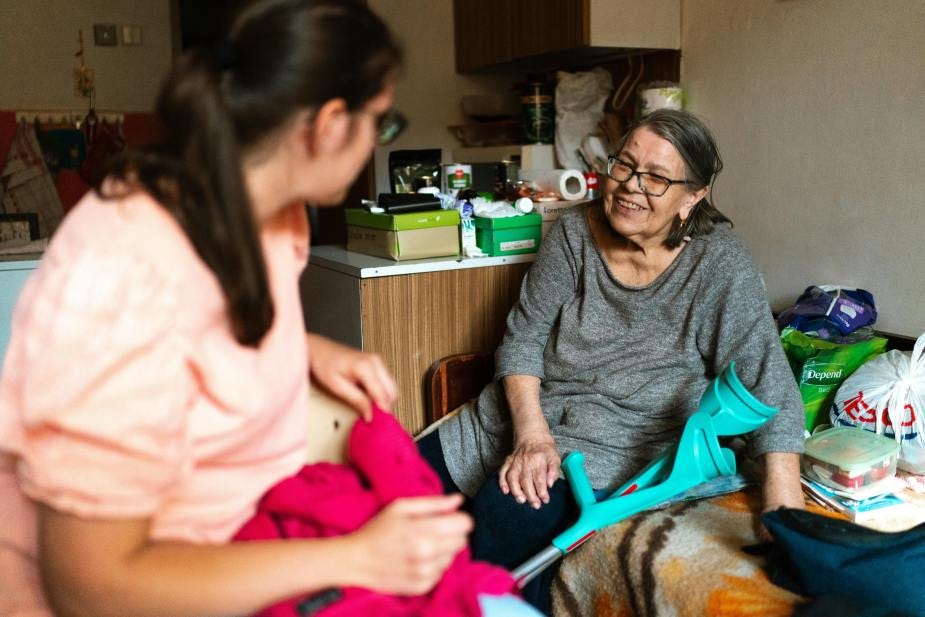
The caring that goes unrecognised
Within South Asian families, care is cultural. It is expected, not as a burden, but as an expression of love, of duty, of who you are. Daughters care for parents. Daughters-in-law care for in-laws. Wives care for husbands. Sisters care for siblings.
The problem is not the caring itself. The problem is that it often happens at the complete exclusion of the woman doing it.
Research from 2026 found that women providing 15 or more hours of unpaid care a week are 57% more likely to experience moderate-to-severe menopause symptoms than non-caregivers. Read that again. The caregiving that South Asian women absorb as a matter of course, quietly, without complaint, is directly worsening the hormonal transition they are already navigating.
And because the caring is invisible, the suffering is too.
What it costs
Caregiving in midlife has a physical cost, disrupted sleep, elevated cortisol, no time for movement, and meals grabbed between other people’s needs. It has an emotional cost, the grief of watching a parent decline, the suppression of your own feelings to hold space for everyone else’s. And it has a health cost, menopause symptoms that worsen under chronic stress, hormonal changes that go unaddressed because there is simply no time.
46% of women aged 40–54 are at high risk of burnout, the highest of any life stage.
South Asian women in this group are not just at risk of burnout. Many are already in it. Running on obligation, on habit, on the deeply ingrained belief that their needs come last.
What Carers Week asks of us
This week, Carers UK and its partners are calling on communities to become carer-friendly places, spaces, services and community groups where unpaid carers are recognised, understood, and valued.
For South Asian women, that call is both external and internal.
External, to the healthcare professionals, the community organisations, and the families who surround these women. See the carer. Ask her how she is. Not her patient, not her parent. Her.
And internal, to the woman reading this who has never considered herself a carer, who has never thought to ask for support because this is simply what she does.
You are allowed to be cared for, too.
That is not selfishness. That is what makes the caring sustainable.
Carers UK offers free support, information, and advice for unpaid carers. Visit carersuk.org or call the helpline on 0808 808 7777.
The post The Invisible Carer: What Carers Week Means for South Asian Women in Midlife appeared first on THE SATTVA COLLECTIVE.